
Happy 250 America
250 is Great but its not the Greatest 4th of July

As America celebrates it’s 250 years in existence, and it is truly great we made it to that, I’d rather focus on another anniversary - Eighty-Seven. You know, that “four score and seven years ago” Lincoln talked about. Because it is the 87th anniversary of the country’s history that was truly its greatest. Not even the century mark yet. Not the centennial of 1876 or the bi-centennial of 1976. And don’t forget, July 4th, 1776 it was 13 loosely bound colonies, not at all a country. By the 1860s there were 34 states as part of a soon to be disunited nation.
Eighty-seven years into the nation’s history it was July 4th, 1863. 4 massive armies were locked in 2 terrible battles that would determine the fate of that nation on toward its 250th birthday, let alone, whether it would even see it’s 100th birthday.
General Lee and the Army of Northern Virginia were in Gettysburg overlooking still smoking fields of wrecked bodies and smashed artillery. General Meade and his men of the Army of the Potomac stared back across the same fields. Between the two armies of men clad in blue and gray 51,000 had fallen (killed, wounded, and missing). Greater than Waterloo. In a civil war no less, not against a foreign nation. American against American. And how many more Waterloo’s need to be fought to settle the contest?
On July 3rd, 1863 as Lee’s divisions were meeting their fate against Union lines 1000 miles away, a lone confederate officer rode on a horse carrying a white flag and a note in his pocket. The note was written by Confederate commander John C. Pemberton, of forces in the besieged Mississippi River stronghold of Vicksburg. His orders were to not return until he personally hand-delivered the note to the Union commander, General Ulysses Grant. He partially fulfilled his orders. He was not allowed to personally give the letter but watched at a distance Grant’s aide-de-camp John Rawlins take it to him. The note read: “Sir: I have the honor to propose to you an armistice for several hours, with a view to the arrangement of terms for the capitulation of Vicksburg. To this end I propose that a commission of three officers be appointed by each army, to meet at such place and time as you may designate, to agree upon such terms as may be deemed just and advantageous both to the Confederate States army and to us. In order to prevent a further effusion of blood, which must otherwise be unavoidable, I feel it is my duty to make this overture to you.”
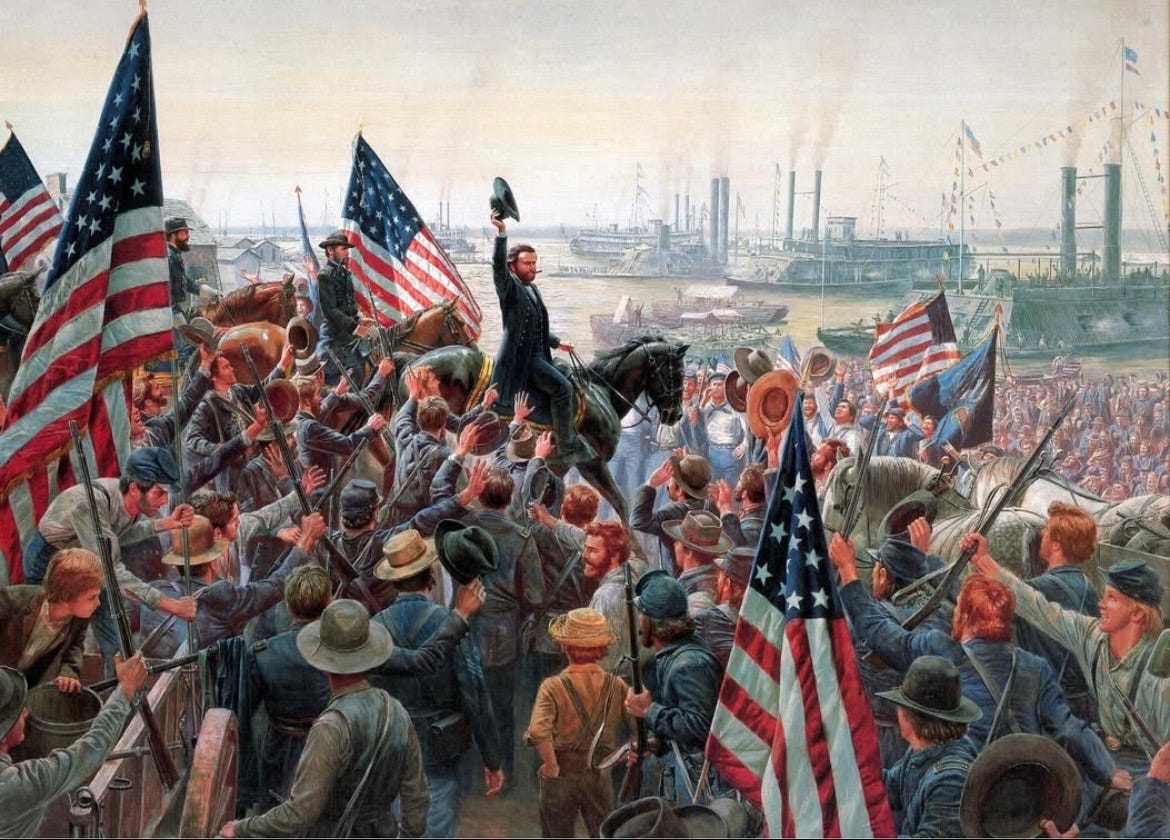
This note led to a meeting in between both lines by a stunted oak tree, another one of those “witness trees” throughout history. True to form and his nickname Grant demanded unconditional surrender. Yet as negotiations progressed Grant relented. He negotiated terms that instead of surrender as prisoners of war the 30,000 confederate defenders would paroled. They would be allowed to leave Vicksburg under the condition they would return home, and not take up arms against the United States again. In Grant’s mind this force was for all intents and purposes already knocked out of the war. The oak tree whose shade the two leaders sought out in the heated Delta sun has long since been whittled away by souvenir seekers. General Pemberton (who was pre-war close friends with Gen Meade) agreed to terms of surrendering the stronghold city, “the Gibraltar of the Mississippi,” that would take effect the very next day, July 4th, 1863.
The 4th was marked by the advancement of the stars and stripes over very hard fought ground. Meade’s army advanced to where Lee’s once stood and Grant into where Pemberton grimly held Vicksburg. What an extraordinary July 4th in the history of our nation it must have been as the telegraph cables sounded off their clicking and clacking to every corner of the land. The Union troops re-entered Gettysburg and the beleaguered Mississippi fortress city. Grant and his men celebrated but mostly sighed collectively in relief. For if Pemberton’s July 3rd note never came, a new attack was planned for July 6th. The Union had been able to dig and burrow under Confederate defensive lines at six points. They packed these places with explosive dynamite. They planned to coordinate and explode all six simultaneously and launch multiple assaults. Thankfully for the sake of the soldiers on both sides an already bloody war was spared another bloody episode.
In Gettysburg, the two armies having spent 3 days throttling each other spent the 4th day staring at each other. Over Culp’s Hill, Cemeteray Ridge and Devil’s Den. Neither side gave battle that day. Lee finally gave the order to withdraw that evening under cover of darkness.
Meade and the men of the Army of the Potomac entered the town of Gettysburg. 4 days before it was nothing more than a small town and farmland. Now it’s name passed into the annals of a nation’s history forever. July 4th, 1863 was marked by the US flag advancing in triumph and the retreat of another flag.
Oddly enough, at the very peak of the this intense civil war, July 4th, 1863 would be a day of celebration and relative peace. Pemberton’s army peacefully walked away from Vicksburg. Grant’s union troops entered and took control of a shattered town and a barely sustained population of starving Southern civilians. The war by no means was over but these two events on the nations’ 87th birthday set it on the course towards the end of that war and after that, an entirely new nation altogether.